I had an interesting experience the first time I went to buy tickets to a football - or 'sakka' (soccer; in Japanese: サッカー) - match in Tokyo. I had been wanting to go ever since finding out that Tokyo had 2 club teams playing in the J League 2nd Division. These being FC Tokyo, who got demoted from J1 last season, and Tokyo Verdy. So one weekend I found out FC Tokyo were playing Yokohama FC at home, and I decided I'd go check it out. Yokohama is just south of Tokyo, about half an hour by train. It's also the 2nd most populous city in Japan. All signs pointed to a healthy derby-like atmosphere.
The game was being played at the Tokyo National Olympic Stadium, which isn't too far from where I live. So the day before the game I walked over moon utha kay, thinking there probably would be a booth or office where I could buy tickets in advance. I looked at the map outside the stadium and started walking towards the information center marked on it.
The national stadium is also a track and field center so there were a bunch of runners doing their drills outside. This stadium held the IAAF World Championships in 1991 for which they still have the leaderboard outside. And one of my favorite athletes' name is right at the top. It was here in 1991 that Carl Lewis ran the 100 meters in 9.86 seconds to set a new world record, which stood for about 3 years. According to Lewis this was the best race he'd ever run.
Anyway after getting a bit sidetracked I finally made my way to the information center. There in my broken Japanese I expressed my desire to buy tickets to the next day's game. But I was very politely told they didn't sell tickets there. One of the ladies behind the desk looked up something on her computer for a couple of minutes and then came to me with a number written on a sticky note with 'Loppi code' written next to it. At first I thought it might be a phone number I needed to call, which would be a real pain to do on my own. But then she said something about Lawson convenience stores, and entering the code she gave me in a Loppi machine. At least that's what I think she said as I only understood about 50% of it.
Lawson stores as I mentioned in an earlier post are everywhere. There are two within a 5-minute walk from my apartment, and luckily there was one right next to the stadium as well, so I didn't have to walk far.

Now, inside each store there is this machine that looks like an ATM called the Loppi.

It's all touch screen, and the big button on the left seemed to say something about entering codes so I pressed that.

I then entered the number the lady had given me. This pulled up another screen with match information. The date and team names matched what I wanted (not in this example, I took these pictures when I went to buy tickets for a different game) so I just hit the button to go to the next screen.

Next the machine asked me what stand I wanted tickets for, giving the various price options. (If tickets have sold out it doesn't let you go beyond this point; if they're still available it asks you how many you want.) Once I made my selection, it asked me to enter my name in Japanese, and then my phone number.

Finally, after confirming all the details, it printed out a receipt. I took this receipt to the store counter where they processed it. My tickets printed right there and then, I paid for them at the counter, and that was that.
It all sounds pretty simple now that I've done it a few times, and it's super convenient. You can buy tickets to just about anything from this machine: sports events, concerts, movies, plays, etc. Each event has its own unique Loppi code, the trick is being able to find the code online, navigating at times Japanese-only websites. But once you have the code then it's just a question of whether tickets are still available or not. Like for example I tried to buy tickets for the recently concluded FIFA Club World Cup but within a few days of going on sale they had all sold out. Or tomorrow FC Tokyo are playing in the quarter finals of the Emperor's Cup (Japan's equivalent of the Copa del Rey or the FA Cup) and that sold out pretty quickly as well.
Just another one of those things where now that you know how its done you wouldn't think to do it any other way. But learning the process itself is the challenge.
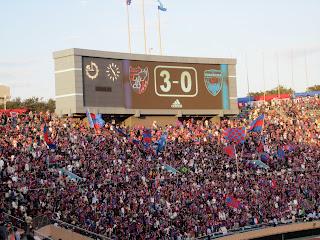
Anyway the game itself was fun. Tokyo ran out easy 3-0 winners over Yokohama. Though the derby-like atmosphere I had hoped for wasn't really there. Or well not by Spanish or English derby standards anyway. There's definitely home and away supporter sections, each with their respective chants (more on FC Tokyo chants in a following post), but true to norms of politeness everything was done in a very civil manner. For example, when a Yokohama player was subbed in the 2nd half, he got an ovation from all sections of the stadium, there was no booing or jeering.
The game was being played at the Tokyo National Olympic Stadium, which isn't too far from where I live. So the day before the game I walked over moon utha kay, thinking there probably would be a booth or office where I could buy tickets in advance. I looked at the map outside the stadium and started walking towards the information center marked on it.
The national stadium is also a track and field center so there were a bunch of runners doing their drills outside. This stadium held the IAAF World Championships in 1991 for which they still have the leaderboard outside. And one of my favorite athletes' name is right at the top. It was here in 1991 that Carl Lewis ran the 100 meters in 9.86 seconds to set a new world record, which stood for about 3 years. According to Lewis this was the best race he'd ever run.
 |
| Leaderboard for Tokyo '91 outside the National Stadium |
Anyway after getting a bit sidetracked I finally made my way to the information center. There in my broken Japanese I expressed my desire to buy tickets to the next day's game. But I was very politely told they didn't sell tickets there. One of the ladies behind the desk looked up something on her computer for a couple of minutes and then came to me with a number written on a sticky note with 'Loppi code' written next to it. At first I thought it might be a phone number I needed to call, which would be a real pain to do on my own. But then she said something about Lawson convenience stores, and entering the code she gave me in a Loppi machine. At least that's what I think she said as I only understood about 50% of it.
Lawson stores as I mentioned in an earlier post are everywhere. There are two within a 5-minute walk from my apartment, and luckily there was one right next to the stadium as well, so I didn't have to walk far.

Now, inside each store there is this machine that looks like an ATM called the Loppi.

It's all touch screen, and the big button on the left seemed to say something about entering codes so I pressed that.

I then entered the number the lady had given me. This pulled up another screen with match information. The date and team names matched what I wanted (not in this example, I took these pictures when I went to buy tickets for a different game) so I just hit the button to go to the next screen.

Next the machine asked me what stand I wanted tickets for, giving the various price options. (If tickets have sold out it doesn't let you go beyond this point; if they're still available it asks you how many you want.) Once I made my selection, it asked me to enter my name in Japanese, and then my phone number.

Finally, after confirming all the details, it printed out a receipt. I took this receipt to the store counter where they processed it. My tickets printed right there and then, I paid for them at the counter, and that was that.
It all sounds pretty simple now that I've done it a few times, and it's super convenient. You can buy tickets to just about anything from this machine: sports events, concerts, movies, plays, etc. Each event has its own unique Loppi code, the trick is being able to find the code online, navigating at times Japanese-only websites. But once you have the code then it's just a question of whether tickets are still available or not. Like for example I tried to buy tickets for the recently concluded FIFA Club World Cup but within a few days of going on sale they had all sold out. Or tomorrow FC Tokyo are playing in the quarter finals of the Emperor's Cup (Japan's equivalent of the Copa del Rey or the FA Cup) and that sold out pretty quickly as well.
Just another one of those things where now that you know how its done you wouldn't think to do it any other way. But learning the process itself is the challenge.
Anyway the game itself was fun. Tokyo ran out easy 3-0 winners over Yokohama. Though the derby-like atmosphere I had hoped for wasn't really there. Or well not by Spanish or English derby standards anyway. There's definitely home and away supporter sections, each with their respective chants (more on FC Tokyo chants in a following post), but true to norms of politeness everything was done in a very civil manner. For example, when a Yokohama player was subbed in the 2nd half, he got an ovation from all sections of the stadium, there was no booing or jeering.


